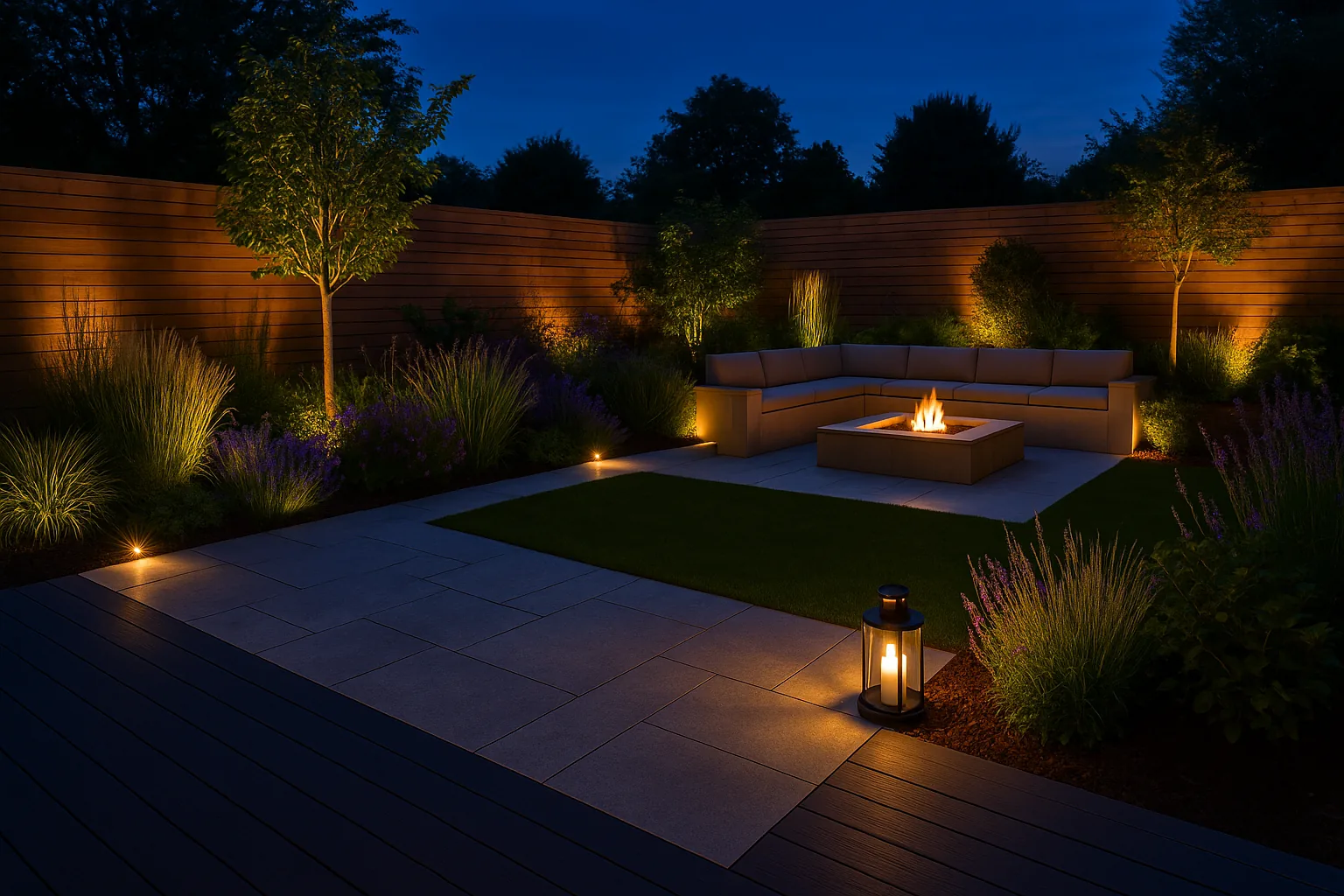
Garden lighting looks beautiful — but get the regulations wrong and you've invalidated your home insurance. A 2026 guide to Part P, IP ratings and voltage choices.
Part P of the Building Regulations — what it covers
Part P of the Building Regulations (2005, last updated 2013) covers electrical safety in dwellings, including gardens. It defines 'notifiable work' that must either be carried out by a registered electrician (Part P-competent person) OR notified to Building Control. For gardens, notifiable work includes any new circuit, any new wiring in a 'special location' (which includes outdoors), and any addition to an existing outdoor circuit. A non-compliant installation can invalidate your home insurance and create issues when selling the property.
IP ratings — what the two digits mean
IP stands for Ingress Protection. The first digit (0–6) rates protection against solid objects and dust; the second digit (0–8) rates protection against water. Common outdoor ratings: IP44 (splash-proof — fine for sheltered locations); IP54 (dust-protected and splash-proof — standard for most garden fittings); IP65 (dust-tight and resistant to low-pressure water jets — good for exposed locations); IP67 (dust-tight and resistant to temporary immersion — for in-ground uplighters); IP68 (continuous immersion — for pond and pool lighting).
Low-voltage (12V/24V) vs mains (230V) — the big choice
12V/24V low-voltage lighting uses a transformer to step mains down to 12V or 24V before it goes to the fittings. The transformer itself sits in a sheltered location (often in the garage or a weatherproof enclosure). Low-voltage cable is much safer to install and is usually not notifiable under Part P — homeowners can install low-voltage garden lighting kits themselves. 230V mains lighting uses standard household voltage and is significantly more dangerous to install. Mains outdoor lighting IS notifiable and should be installed by a Part P-registered electrician.
Why we use low-voltage for nearly every garden install
We specify 12V or 24V LED lighting for around 95% of our garden lighting projects. Reasons: (1) significantly safer for the homeowner and any future DIY work; (2) usually not notifiable under Part P; (3) much wider range of high-quality fittings; (4) LED at low voltage is the most efficient lighting technology available; (5) cabling is much simpler and faster to install. The transformer sizing is the key engineering step — undersize and the lights dim toward the end of the run; oversize and you waste money.
Colour temperature — get this right or regret it
LED colour temperature is measured in Kelvin (K). 2700K (warm white) is the closest to traditional incandescent and is what we use for nearly all garden lighting — flattering on planting, foliage and natural stone. 3000K (warm-neutral) works for contemporary schemes. 4000K+ (cool white) looks clinical and washed-out in a garden setting and should be avoided. 5000K+ (cool/daylight) is for commercial security only — it ruins the atmosphere of a residential garden.
Lumens — how much light do you actually need?
Garden lighting is about creating mood and highlighting features, not flooding the area. Typical lumens per fitting: path lights 80–150 lm; spike-mounted uplighters on planting 150–300 lm; tree uplighters on mature trees 400–800 lm; wall-wash floods 600–1,200 lm. Cumulatively a typical residential garden lighting scheme uses 3,000–6,000 lumens total — far less than people expect.
Light pollution and the BS 5489 guidance
BS 5489 covers exterior lighting design. Two principles worth keeping in mind: (1) light fixtures should be directed onto the feature you want to light, not into the sky or onto neighbouring properties; (2) overall light levels should be appropriate for the location (a quiet residential street needs much less light than a town centre). Local council nuisance enforcement is increasingly active on excessive residential floodlighting.
Conservation areas and listed buildings
External lighting on a listed building (or one in a conservation area) often requires consent. Even where consent isn't strictly required, conservation officers usually want fittings to be discreet — bollards in dark bronze or black, recessed in-ground fittings, or wall-washers with anti-glare hoods. Bright contemporary fittings on Victorian/Edwardian properties almost always get pushed back.
Smart-control options for 2026
Most modern low-voltage LED gardens can be paired with a smart transformer (Lutron, Hunza, Lumena and several others) for app and voice control, dimming, schedules and scene presets. Realistic budget for smart control on a typical garden: £350–£900 above standard wired transformer pricing.
What we include in every garden lighting quote
Our free instant quote tool includes a basic lighting design (number of fittings, type, transformer size, cable run) for any quote that includes lighting. For larger projects we produce a full lighting plan with fitting selection, colour temperature, lumen output per zone and transformer sizing — included free of charge.
Frequently Asked Questions
Do I need an electrician to install garden lighting?
For low-voltage 12V/24V lighting from a plug-in transformer, usually no — the work isn't notifiable under Part P. For any 230V mains outdoor lighting or any new circuit, yes — it must be done by a Part P-registered electrician and certified.
What IP rating do I need for outdoor garden lights?
Minimum IP44 for sheltered locations, IP54–IP65 for exposed fittings, IP67 for in-ground uplighters and IP68 for pond/pool lighting.
Why does colour temperature matter for garden lights?
Cool-white LEDs (4000K+) wash out planting and natural-stone materials and make a garden look clinical. Warm-white (2700K) is what you want for nearly all garden lighting — it flatters foliage, brickwork and stone.
Related Reading & Service Pages
Read next: Outdoor Garden Lighting Ideas
Relevant service: Visit our garden lighting service →
See real installs: Browse our project case studies →
Areas covered in this article:
Get your free instant quote & AI garden design
Itemised pricing plus a free AI design preview — delivered in under 90 seconds. No charge, no obligation, no sales call.
Get My Free Quote & Design