
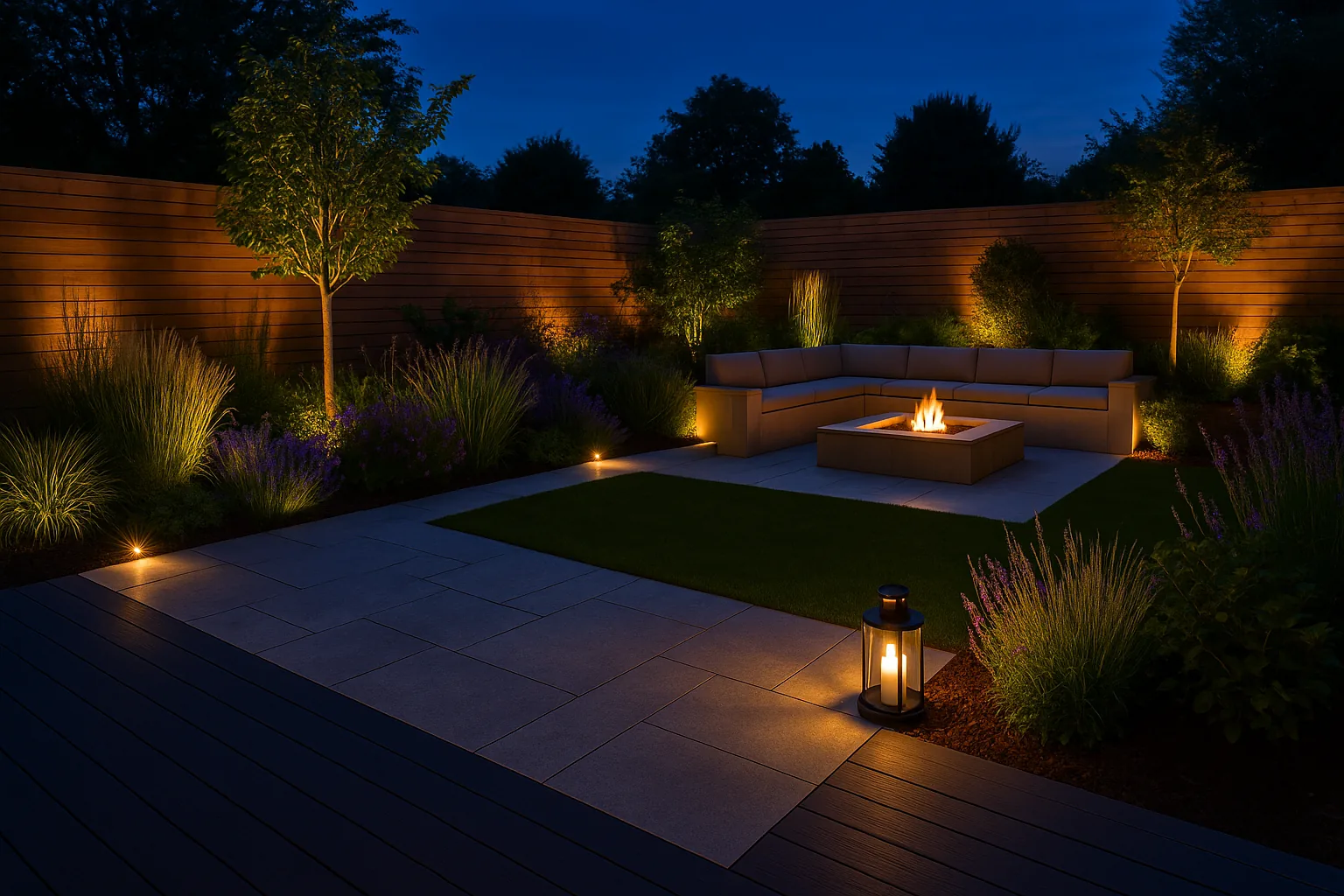
Professional outdoor lighting extends your garden's usability into evening hours and creates stunning ambiance. Explore the best lighting options for UK gardens in 2025.
1. Path & Step Lighting
Essential for safety, path lights guide visitors through your garden after dark. LED spike lights work perfectly for pathways, while recessed lights built into steps prevent trips and falls.
2. Feature Spotlights
Highlight architectural features, specimen plants, or water features with adjustable spotlights. Warm white (2700-3000K) creates inviting ambiance, while cool white (4000K+) suits modern minimalist gardens.
3. Deck & Pergola Lighting
Built-in deck lights or string lights overhead transform patios into magical evening entertaining spaces. Smart LED strips allow you to adjust brightness and color from your phone.
4. Wall Wash Lighting
Create drama by washing garden walls or fences with soft uplighting. This technique adds depth and makes small gardens feel larger.
5. Smart Control Systems
Modern garden lighting integrates with smart home systems. Schedule lights to turn on at dusk, adjust brightness remotely, or create different scenes for entertaining vs relaxing.
Energy Efficiency
LED lighting uses 80% less energy than traditional halogen bulbs and lasts 15-20 years. Solar-powered options work well for path lighting in sunny spots, though mains-powered LEDs provide more reliable brightness in the UK climate.
Add Professional Lighting to Your Garden
Get an instant quote for outdoor lighting installation.
Get Instant Quote & DesignUnderstanding IP Ratings for Outdoor Lighting
Every outdoor light fitting has an IP (Ingress Protection) rating that tells you how well it's protected against moisture and solids. For UK garden installations, this is not optional reading — specifying a fitting with the wrong IP rating for its location is the most common cause of early failure and potential electrical hazard.
The IP rating consists of two digits: the first covers dust and solid particle protection (6 is the maximum — fully dust-tight), the second covers water protection. For garden lighting, the second digit is the one to focus on. IP44 means protected against water splashing from any direction — suitable for wall lights on covered porches or in reasonably sheltered spots. IP65 means protected against water jets — suitable for exposed garden positions, pathway lights and most above-ground exterior use. IP67 means protected against temporary immersion — required for in-ground uplighters or any fitting that will stand in pooling water. IP68 means protected against continuous submersion — required for pond lighting and water feature fittings.
We specify the correct IP rating for every fixture position on every installation. Never accept a lighting scheme that doesn't document the IP rating of each fitting relative to its position — particularly if there are water features, in-ground lights, or areas prone to puddling.
Smart Garden Lighting: What's Worth Paying For
Smart garden lighting systems — those controllable via an app, voice assistant, or home automation platform — have become significantly more affordable and reliable in the past five years. For a Leicester garden, the features most worth paying for are: dusk-to-dawn automation (lights turn on at sunset and off at sunrise without you thinking about it), zone control (different areas of the garden on separate circuits), and scene-setting (pre-programmed combinations of brightness and zone for entertaining, security, or relaxed evenings).
What's less worth the premium: colour-changing RGB lights for garden use. While they photograph beautifully, most homeowners use a warm white setting 95% of the time, and RGB fittings are typically less energy-efficient and more prone to failure than single-colour LED equivalents.
The most cost-effective smart system for a typical Leicester garden is a quality low-voltage transformer with a built-in programmable timer and photocell, paired with quality LED fittings throughout. For homes already using smart home platforms like Google Home or Amazon Alexa, smart bridge controllers allow integration without replacing the fittings.
Garden Lighting Design Principles
The most common mistake in garden lighting design is overlighting. More isn't better — a few carefully positioned fittings create far more atmosphere than a garden blazing with lights from every angle. The goal is to illuminate features and create depth, not to eliminate shadow entirely. Shadows are what give a lit garden its drama.
A good garden lighting design uses a minimum of three layers: task lighting (paths, steps — safety), feature lighting (trees, walls, architectural elements — drama), and ambient lighting (seating areas — warmth). Each layer uses different fitting types at different heights and angles. When all three are present and balanced, the garden reads as a cohesive, designed space.
Directionality matters enormously. Uplighters beneath trees create a completely different effect to downlighters in the canopy above them — the former is theatrical and dramatic, the latter more naturalistic. Grazing light across a wall texture (running the beam close and parallel to the surface) reveals every detail of the material. Cross-lighting a water feature from two angles eliminates the flat appearance that single-point lighting creates.
What Garden Lighting Costs to Install in Leicester
A professionally installed garden lighting scheme in Leicester — typically covering path lighting, 2–3 feature uplighters, deck or patio ambient lighting, and a transformer — starts from around £800–£1,200 for a modest system on a standard garden. Mid-range schemes with smart controls and 8–15 fittings typically run £1,500–£3,000. More extensive schemes with multiple zones, water feature lighting and high-end fixtures can reach £4,000–£6,000.
The running cost of a well-designed LED garden lighting system is very modest. A typical Leicester garden with 15 low-voltage LED fittings running 5 hours per evening uses approximately 2–3kWh per day — roughly 50p at current electricity prices. Annual running cost: around £150–£180. Smart timers and dusk sensors ensure lights only run when needed.
Garden lighting is also one of the few home improvements that pays back in multiple ways: extended usable space, enhanced security, improved kerb appeal after dark, and increased property value. Get a free instant quote from our team to see what a professional lighting scheme would cost for your specific garden.
Frequently Asked Questions
How much does garden lighting installation cost in Leicester?
A professionally installed garden lighting scheme in Leicester starts from around £800–£1,200 for a modest system with path lights, 2–3 feature uplighters and a transformer. Mid-range schemes with smart controls and 10–15 fittings typically cost £1,500–£3,000. More extensive multi-zone systems can reach £4,000–£6,000.
What IP rating do I need for outdoor garden lights?
For standard garden positions, fittings should be at minimum IP65 (protected against water jets). For in-ground uplighters or fittings in areas that pool after rain, IP67 is required. For pond or water feature lighting, IP68 is the minimum safe specification. Always confirm the IP rating of any fitting relative to its specific position.
Can I install garden lighting myself?
Low-voltage (12V) garden lighting systems are DIY-friendly since they operate at a safe voltage. Mains-voltage garden lighting (230V) must be installed by a qualified electrician and any exterior circuits need to be protected by an RCD and notified to building control. For safety and warranty reasons, we always recommend professional installation for permanent garden lighting systems.